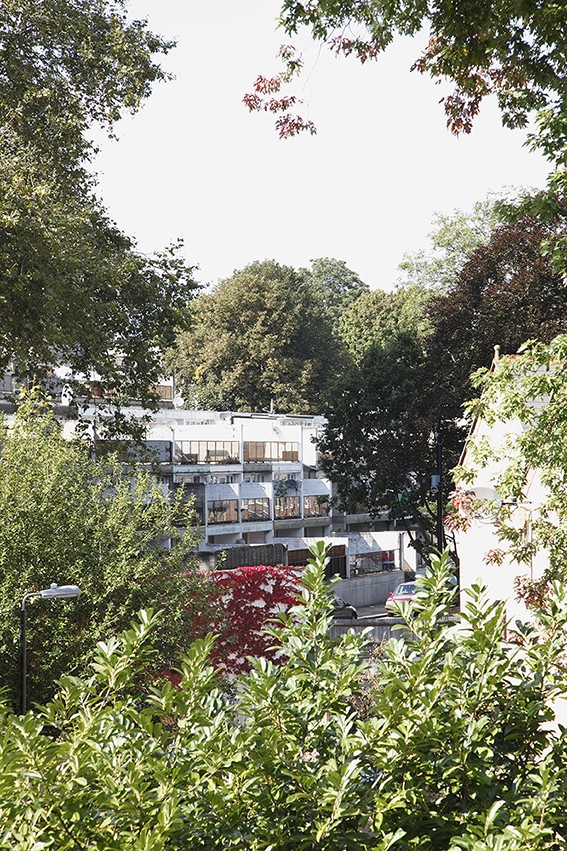
Just facing the northwest corner of the Triangle, lies the Central Hill Estate, an award winning development of social housing, built between 1966-73, by Lambeth's architecture department lead by Ted Hollamby, and designed by Rosemary Stjernstedt, which is now, sadly under threat of possible demolition. Some of you may think that fate is no bad thing. Architecture of that period is not widely loved, but then 50 years ago nor was Victorian architecture. Amazing to think now that a building as magnificent and loved as St. Pancras railway station and its adjoining hotel, came close to demolition. And while of course that building is in a different league, there is a deep attachment to the endless streets of ordinary 19th century terraced homes up and down the country, plenty of which are in pretty shoddy condition. We wouldn't think for one moment of demolishing them though.
But this isn't just about architectural tastes, it's about a community and people. A couple of months ago, I went to meet Nicola Curtis, a council tenant on the estate, who earlier this year started a campaign to save it. Part of what motivated her was the complete lack of transparency on the part of Lambeth Borough Council. In fact the role of the council in the history of this estate has been poor from the very start. Decades of neglect have resulted in the situation the estate now finds itself, and having neglected things so long, the council now can't afford to address all the problems that the buildings face, and are therefore seeking to effectively sell off the estate to developers with deeper pockets. Initially residents were lead to believe that this involved refurbishment with some rebuilding, but the likelihood is that actually wholesale demolition will be proposed, forcing people, some of whom have lived there since the estate was built, to move away. The stress and frustration of many on the estate is understandable. Nicola herself is recovering from a stroke earlier in the year, so the upheaval is the last thing she needs. Not far away, the Cressingham Estate has undergone a similar exercise, and its fate has already been sealed.
On my tours around the neighbourhood, I discovered a collection of buildings which make the most of their landscape, topography, and views towards the city. Blocks stepping down the green hillside with generous balconies and terraces, and the rustic brick paths, the human scale, and the absence of cars from all but the periphery. I saw the pride residents have taken in their gardens, and the vision of the architects who created the estate. Yes, all is not perfect of course, but much of the trouble often associated with estates such as this, are mostly a thing of the past. People are seeing the positives of these well designed homes, and their perfect location on the doorstep of the Triangle. Slowly but surely it's becoming an increasingly desirable place to live. Why then can't it follow the example of the not dissimilar Alexandra Estate in Camden, which is now a listed structure, and with it's future assured, is thriving.
 |
| Nicola Curtis with her granddaughter |
 |
| A view from the estate |
 |
| One of the rather whimsical fort-like refuse points, taken during an Open House London tour lead by Senaka Weeraman. |
 |
| Enclosed courtyard gardens with green roofs above the bin stores. |
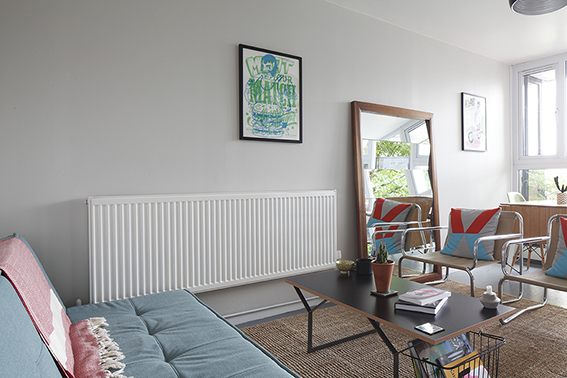
Through my research, I was fortunate enough to meet David Taylor, who moved onto the estate only a year or so ago. His home was in a pretty poor state when he bought it, but he has transformed it into cool and relaxed apartment, furnished sparingly with some suitably midcentury pieces. He kindly gave me permission to have a look around.
 |
| David on his balcony |
 |
| London's skyline from the balcony |
I would like to thank Nicola Curtis for talking to me, and for her tireless campaigning, David Taylor for allowing me to photograph his lovely apartment, and Senaka Weeraman who was a knowledgeable tour guide during London's Open House weekend.